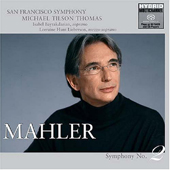
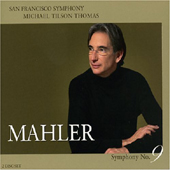
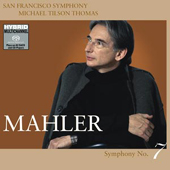
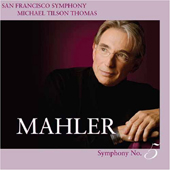
In 2001, the San Francisco Symphony Orchestra launched their own in-house recording label called SFS Media. They were the first American orchestra to
establish its own music label, and since then many other fine ensembles and individual artists from all around the globe have decided to go the independent
route, each and everyone of them with very good and promising results.
In its first year of operation, the SFS executives had decided on releasing each recording only through mail order and in runs of limited edition quantities, but the demand from Mahler fans around the world
has been so great that even now, eight years later, all the recordings are still selling more than anticipated, and have surpassed the 130,000 unit mark worldwide. Very impressive for an independent label.
So far the cycle has received 10 Grammy nominations, 4 of which became Award Winners. Michael Tilson Thomas has always been a strong supporter of live recordings and therefore every recording in this impressive
series has been captured during live concerts, giving them an extra sense of occasion and allowing us to feel that raw nervous energy omnipresent on stage. All recordings are Super Audio CD Hybrids playable on
SACD machines and on regular CD players. They all sound magnificent reproduced in CD Stereo, therefore they must be truly impressive in SACD Surround.
Gustav Mahler (1860-1911), was a composer who was blessed with the ability to manipulate and merge together various musical elements, and build symphonic works to a point of the highest technical virtuosity and philosophical/musical content,
all by sheer intellectual force and resolve. No other composers before or after, managed to bring together all the aspects of music to their full potential like Mahler could. As it has been mentioned many times before,
he truly built worlds within his symphonies. Mahler symphonies, when well performed, can take the listener to a different realm and enrich the soul. Because he was also a great conductor, he knew that in order for an orchestra
to achieve its full potential, each and every individual musician had to master not only their parts but also be aware of the role their parts played within the body of the composition, and therefore become one entity, one living organism.
He played a crucial role in the transition from 19th to 20th century musical developments. After his funeral in 1911, a New York music critic had written 'We cannot see how any of his music can long survive him'. True, he was rather neglected
until around 1950, but today his music is scrutinized, studied, performed, recorded and written about on a daily basis.
Note : The symphonies listed here are in the order in which they were recorded and released
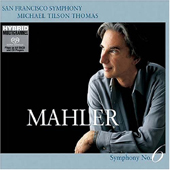
Symphony No. 6 in A minor Recorded : Sept 2001 - Released : June 2002 - SFS0001 - 0821936000120
This is the symphony that launched this cycle, and be it an act of fate or just one of those crazy coincidences (Mahler finished writing it on September 9th 1904), the first recording session took place during a live performance on September 12th, 2001.
The day following the devastating events of 9/11, a dark and tragic day in human history. I would say that it is reasonable to assume that everyone involved
in this project, be it the conductor, musicians, recording engineers ... must have been not only sleep deprived, but still rather anxious and horrified by the
previous day's events. But somehow, and maybe because of all this, they all suddenly and collectively grasped and felt a deeper understanding of this grim
and tragic work, and in my opinion, managed to produce one of the most convincing interpretations of this awe-inspiring masterpiece by Gustav Mahler.
Even though the overall mood of this symphony is dark and ominous, Michael Tilson Thomas does not let the music wallow in darkness and bathe in self-pity
like some conductors have been known to do. He doesn't let the powerful emotions within the work drag the music down into a world of severe depression. He gives a strong pulse
and sense of purpose to the ongoing turmoils, as if to say "You can try and take me, but I am not going down without a fight". After all, the grim march that opens the first movement
has a heroic and stoic quality to it, and the constant harmonic shifts from major to minor, propel the music forward into epic struggles and shows that this is not a one-sided fight.
The soaring and passionate second subject of the first movement, the 'Alma' theme, is what prevents the music from falling into the abyss, and in this recording really blossoms and triumphs over tragedy.
After a live performance, Mahler had decided to invert the order of the two middle movements, and ever since a debate has existed over the proper sequence of the inner movements. In this recording,
Tilson Thomas has chosen to position the slow movement as the third movement, preceding and leading into the final movement, which to me is the correct sequence as I explain later.
And what a wonderful slow movement it is. This is Mahler's most bucolic and blissful moment. No anguish or spectres anywhere. Michael Tilson Thomas judges the tempo and nuances perfectly
and sets the sound of the cowbells just right within the lush textures, and doesn't spotlight them like some conductors. The orchestral tone fits the mood perfectly and carries you aloft in this dream world.
But all dreams must come to an end, and this is where the proper sequence of the movements comes into play. The first note of the final movement sounds
like a thud, like a bump in the night, almost like someone abruptly waking you from a deep slumber and saying; "Wake up and face the world, it's time to
deal with your deepest fears". And this segment of the symphony is all about ghosts in the closet, spectres from the past and that dreaded military sounding
percussion from the opening movement. Major conflicts and struggles come and go, with powerful moments underpinned by hammer blows of devastating
force, in this performance sounding exactly as Mahler had intended, like an axe felling a tree. Again, Michael Tilson Thomas controls all the conflicting
elements very well and brings the orchestra to a boil quite a few times, leading to the best closing pages I've ever heard. That final moment where the
forces of good rise up for the last time before being silenced for ever is truly breathtaking in its scope and power. But evil again takes over and covers
every bit of hope in a cloud of darkness, and the military drum has the final word.
This is beyond a doubt, the best performance and recording of Mahler's 6th. It has a constant sense of purpose that even in the darkest and bleakest of
moments, never deviates from its trajectory, and a strong thematic line from start to finish that definitely accentuates the "classical" structure of this great work.
What a dramatic difference there is between Mahler's 6th and his Symphony No. 1, especially when you listen to them in that order. But yet, everything that
is Gustav Mahler is present in his first large scale work. Mahler's favorite harmonic interval of the fourth, off-stage horns, brass choirs, long melodic lines, slow
and far-reaching developments, a wide range of percussion instruments, Jewish folk tunes, marching band rhythms, abrupt mood shifts, the masterful merging
of various subjects and thematic material, dark and profound passages pitted against bright and glorious outbursts of passion, etc ... And all the typical Mahler
musical gestures and contrasts are here, including the sounds of nature, the funeral marches, the drunken irreverent human follies, the cataclysmic defeats
and the heroic triumphs.
I believe the root of the difference lies mostly in the outlook of each work, with the 1st being an optimist and somewhat innocent composition from a man who
had not yet been subjected to the evils of life. Near the end of the last movement, Mahler incorporates the melody of "And he shall live forever and ever" from
Handel's Messiah into the orchestral fabric to accentuate the belief that when a man dies, his essence and spirit live on. A true contrast to the general outlook of his later
symphonies. But because it is an early work written by a composer in his twenties, it is full of energy and bravado. Take for example that wonderfully
achieved sudden key change at the 10:00 minute mark of the last movement. Nothing else portrays power and invincibility quite like that uplifting gesture.
Definitely one of the most assured and creative first symphonies ever written.
In the booklet notes, Michael Tilson Thomas wrote that when he first heard this music at the age of 13, it came as a shock. All the elements within the work
seemed to create in music a wide horizon over which an entire world of sound was stretched. He felt himself in an enormous landscape, a landscape of music
within which the whole dance of human experience and feeling was occurring.
And that is exactly how Michael Tilson Thomas and the San Francisco Symphony members view and present this work in this live recording. From the hushed
opening pages to the final heroic horn calls, they push the music to its limits and deliver a thrilling account of this ground breaking symphony.
Addendum - May 2012: After reading this review, Paul Barasi was kind enough to point out to me that what sounds like
a melody from Handel's Messiah during the last few pages of the final movement, is actually the main subject from an unfinished Suite in E
by Hans Rott, written in 1878. It is known to have been heard by Mahler on May 27th 1878, when this work and one of Mahler's were both played at a Vienna Conservatory examination performance.
I knew that Mahler and Rott were close friends during their student years and exchanged ideas and studied each other's scores, and that Mahler's First shows
evidence of influence from Rott's First. In fact, I've listed a recording of Rott's Symphony on this site's "Recommendations" page. What I didn't know, until now, is that the 7 note melody that opens Rott's Suite is incorporated, note for note, within the main
fabric of Mahler's first symphony's final movement. Thanks to the factual information forwarded to me by Paul Barasi, I now stand corrected. Now, does the musical/philosophical
connection to the Messiah still stand? I'm not so sure.
You can judge for yourself. Here's a recent review of a recording featuring the music of Hans Rott including the Suite in E which includes an audio clip.
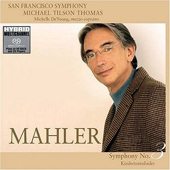
The first thing you see when opening the CD booklet is a great photograph of Gustav Mahler on one of his treks up the foothills of a mountain near his summer
home. A picture that captured Mahler at the peak of his life. And this is what his Symphony No. 3 is all about. Life within the full spectrum of existence. Mahler
was a lover of nature and a pantheist, and this symphony is about all the aspects of nature in both physical and spiritual forms. To me it is more about the
inner workings of life. The energy, life force, drive, love and soul within living things and inanimate objects, and also about how we perceive and respond to
the forces around us. Everything in life that is beautiful, ugly, wonderful, strange, peaceful, violent, grotesque, evil and awe-inspiring is captured within the
score of this great work. Mahler was so in touch with nature, that Franz Lösch, the man who built his composing-hut at Steinbach in 1894 once recalled: "Mahler
would always say that the lake had its own language, that the lake talked to him. When he heard the lake, he composed more easily, and the music flowed fully
formed from his head".
It is the only Mahler symphony that is completely optimistic in its outlook and utterly pregnant with joy. The colossal first movement lasting over 36 minutes,
opens with an impressive statement played by eight horns portraying the raw and primitive energy of nature. The San Francisco Symphony members are up to
the task and begin this recording with full power and gusto, and 106 minutes later, end the symphony in radiant glory with energy in reserve. The second
movement, "What the flowers in the meadow tell me" is the complete opposite of the first. It is delicate, sophisticated, almost perfumed, and with the perfect
orchestration to distance itself from the elemental forces of the opening movement, and again, Michael Tilson Thomas and his players adapt effortlessly to the
demands at hand and deliver a most floral account. The third movement, "What the creatures of the forest tell me", with its evocative and haunting posthorn
solo and its portrayal of fright at the presence of man near the end, has never been captured so well as in this recording.
The fourth movement, based on words by Nietzche, "What night tells me" or in some editions "What man tells me", with its profound solo for mezzo-soprano performed here to perfection
by mezzo Michelle DeYoung, seems to suggest that what mankind brings to the table is not so pleasent and joyfull. My only quibble here is that the vibrato in
Michelle DeYoung's voice is sometimes so pronounced as to become distracting, but the quality of her singing more than compensates for it, and the orchestral
layers of sound supporting it all are true to the sombre and profound mood of this segment. The fifth movement, "What the morning bells (angels) tell me", with
its use of tubular bells and chimes, the Pacific Boychoir, San Francisco Girls Chorus and the Women of the SFS Chorus all singing about heavenly joys, is a direct
and powerful contrast to the preceding movement. And again the SFS members and all the singers involved are all in impeccable
form and in true accordance with the written score.
All of this brings us to the sixth and final movement, "What love tells me", one of Mahler's finest Adagios. I believe that this movement is the nucleus of the
symphony. It is what everything else gravitates to, both in ideological terms and in musical terms. It is a tour de force of slow and sustained energy from start
to finish, with minute incremental changes in its intensity, slowly leading us upwards level by level. A great example is when the choir of trumpets takes over
the main theme from the strings as we come closer to the end. One of Mahler's most breathtaking moments indeed performed accordingly by the SFS brass
players. Now at a timing of 26:31 minutes, Michael Tilson Thomas delivers the slowest interpretation of this movement that I know of, and as a matter of fact,
the first time I heard it a few years back, my first impression was that it was too slow. But the more I listen to it, the more it works. Mahler's own tempo
indications for the last section of the movement are simply this: 'Empfunden'. Which means 'felt' or 'perceived', and therefore leaves plenty of room for
interpretation. I assume that this conductor's 'perception' of the sublime coda is as follows. In this symphony, Mahler realised and achieved nature's perfect
balance in musical terms, and without this balance, Life would cease to be. And that is such a broad and profound concept, it need not be rushed.
It has always been a firm belief of mine that the genesis of every Gustav Mahler symphony originates from deep within his psyche. That the catalyst for his
inspiration stems from a deep and profound emotion combined with lucid memories of time past. Mahler did not feel the need to write new works simply to
explore a new key structure or to experiment with different rhythm patterns. He composed new symphonies because he had to express himself by creating,
in music, his interpretation and reaction to the world around him. Now for most of his symphonies the basic emotion or intellectual stimulus that drove him
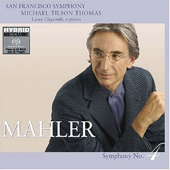
to write them is fairly obvious, but not so much for Symphony No. 4. I have always considered this one to be a harder nut to crack than the others.
It's definitely an extension of Symphony No. 3, because as we all know, the last movement of No. 4 was originally written much earlier and was meant to be
the seventh movement of No. 3 but then discarded. I believe it's subject matter is still about nature and life, but observed from a different angle. It is a look
back at life during childhood. Innocent, free, sunny, unburdened by the responsibilities and duties of adulthood.
The opening movement is most certainly a trip through the countryside on a sunny day, sitting in a carriage pulled by sleigh belled horses, or at least sounds
that way. But don't be fooled. There is a subtle dark undercurrent and shadowy mood that lies beneath the surface, which eventually reveals itself with a look
to the future by interjecting the grim trumpet notes that open the 5th symphony, and a glance to the past with a brief motif from the 2nd symphony. This is
exactly one of the best qualities within the way Michael Tilson Thomas conducts this work. His approach is always clear, always lucid, sunny and clean, but
with a deep sorrow and underlying fear, always present just below the surface. The following scherzo movement was originally headed (Friend Hein Strikes Up).
Hein was a sinister figure in German folklore, sort of like a pied piper, who led his followers to the land of the dead. Definitely childhood fears resurfacing
later in life.
The slow movement, the Adagio, is one of Mahler's best in its simplicity and tenderness. Almost like the slow rocking of a cradle, or rather like lying on your
back in a small boat flowing down a lazy river while gazing at the clouds above. Here again is the paradox. Did you know that Mahler's inspiration was of a
vision of a tombstone with a carved image of someone in eternal sleep? Regardless of the image, it is a wonderful movement, and is one of the high points
of this entire cycle. Tilson Thomas uses just the right pace, the right nuances, and a silkiness in the sound unachieved by anyone else. And when comes time
to open the gates of paradise at the end, the orchestra just glows with radiant beauty.
The soprano Laura Claycomb steps in during the last movement, to sing about the joys and bliss of heaven as imagined through a child's eyes. Her voice suits
the text and character of the music perfectly and brings the whole symphony to a peaceful close. This is very much so a recording to rival any recording of this
work and is one of the highlights of this cycle. The recorded sound is superb in every way and belies the fact that this is a live recording. Highly recommended!
This magnificent symphony was the first large scale symphonic work to exceed its limits, to push past its boundaries and to transcend music itself and assume an energy, a life of its own. In other words, to become more than the sum of its parts and reach farther than the composer's intent. And what's even more amazing, is the fact that Gustav Mahler accomplished all that whilst still following all the theoretical laws and rules of music. Certainly there had been large scale works before this from Beethoven or Bruckner, to cite but two examples, but those remained strictly in the realm of pure music. What Gustav Mahler infused within his Symphony No. 2 was a life force, a soul, an emotional and spiritual energy unheard of before.
Because of its breathtaking scope, many conductors come at it with a paint roller, and paint right over the details. Michael Tilson Thomas on the other hand uses a variety of brushes to paint the same picture and brings out the fine details. His reading is always lucid and clear, with the glorious ending always in his sights. Take for example that first quiet glimpse of heaven, starting at the 6:25 mark of the first movement. Very well put across here. He keeps power in reserve for when it is really needed. A prime example of that is at the 15:40 mark of the same movement where power and weight are delivered with awesome force.
The charm and mood of the second movement are very well captured and the plucked strings near the end perfectly done. The third movement brings with it the eternal question "Why must we die!" And that final act of defiance, that fist pointed to the sky, that 'cry of disgust' at the 8:00 mark followed quickly by another glimpse of heaven is terrifying in its brutal force.
The way the late Lorraine Hunt Lieberson sings the first three notes of the fourth movement, 'O red rose!', is simply breathtaking in its deep sorrow, and the final phrase 'that will lead the way to eternal blessed life' has never been so beautiful. And then we arrive at the final gigantic movement which starts with a terrifying cry of anger. It evokes the Last Judgement in a series of scenes. The brass choir that starts at the 7:00 mark is unmatched here and leads to an overwhelming first full look at everlasting light that will send shivers down your spine. The massive drum rolls that follow are terrifying in their power and lead into the procession of the dead, the Dies Irae march to the end, which culminates in sheer terror with powerful cries of anger and cries for mercy. Then we come to the magical moment of this symphony. The off-stage horn calls summoning the dead to rise. The resurrection section begins with a distant choir of angels urging us to rise, which is perfectly done in this recording.
If you don't feel anything when the soprano Isabel Bayrakdarian joins the choir, then your heart must be made of stone. Michael Tilson Thomas holds everything back and well controlled until we get to the part where the organ joins in and then lets all the power that everyone had in reserve just come gushing out in a final uplifting gesture. One of those great Gustav Mahler musical statements, when the musical notation just leaps off the page.
When you study this symphony's score and marvel at its magnitude and complexities, it is almost impossible to believe that
Gustav Mahler completed this masterpiece in a matter of about three months. He started it in June or July and had it finished by September 2nd, 1909. Some revisions
were done until March of the following year, but the bulk of the work was done in three months. I realize that by that time, Mahler had become a master of his craft,
but to bring to fruition all the elements involved in creating such a large and profound composition in so short a period of time, truly emphasizes his genius. According
to Ernst Decsey, a music critic and editor of a Graz newspaper at the time, Mahler's favorite saying was 'Vita Fugax' (This fleeting life), and
everytime he uttered it there was a sense of desperation at not being able to fill every hour of his life with the riches of his mind, and not being able to turn every
moment into a moment of action. It was his fundamental nature to throw himself into work.
It is my opinion that the first movement alone is the best work of music ever written. It has a solid musical argument, a tight and grand structure, and a long, arch-like development second to none. It soars the highest peaks and plumbs the deepest precipices. It tests and pushes the boundaries of harmony, but yet obeys all the rules. Simon Rattle once noted that although the first movement is in D major, the confirmation of that is only made clear on the very last note, that high D played by a solo flute. Therefore, for 30 minutes, it revolves around harmonic instability without ever collapsing. Again, what makes this recording so good is the strong focus that Michael Tilson Thomas holds on all the separate threads of music and his ability to expose all the details within this ocean of notes.
On an emotional level, the first movement of the 9th is very much like the final movement of the 6th. They both represent epic battles against a mighty foe intent on taking you down. In the 9th, it's a face to face encounter with Mahler's arch-enemy, death. He had in fact recently been warned by his doctor that he had not long to live, due to a blood infection that was tasking his heart. The life elements in the music, constantly reaching higher, are pushed back down three times, the third time 'with the greatest force', which is exactly Mahler's own expressive notations over that impressive passage where hundreds of notes come cascading down into a horrifying crash, and the music just simply collapses under the brutal attack, quickly followed by those demon horns. And this is where Michael Tilson Thomas and the SFS players shine. When the life motif slowly limps back and ever so faintly regains energy, you would think the musicians themselves have just been to hell and back it's so well done. Then this
movement ends, on that high D, with a tender glimmer of hope.
The second movement sounds like a recollection of youth. Of days spent having to participate in rustic country dances, and having to endure tawdry, simple-minded music that sounded empty. Music that left a bad taste in your mouth. The whole movement is like a spooky and grotesque Viennese waltz played by a Bavarian Oom pah pah band, and the SFS players relish in it.
The third movement is Mahler gone mad. A great edifice built on dissonant counterpoint, disjointed rhythms, crazy outbursts, demented march music, all being driven forward in a frenzy by Mahler's stupendous sense of development. It ends with a bang with each and every instrument of the orchestra playing the last three notes at full speed and full power.
In this symphony, it is again the final movement that is the focal point and emotional center. Notice if you may, a strong statement of faith that Mahler introduces within the music a few times, played very softly and lasting only for two bars. It is first heard within the very first page of the score, at bar number eleven. It is the bass line motif from the Johann Sebastian Bach Chorale Prelude 'Nunn komm der Heiden Heiland' (Come Thou Redeemer). It turns the whole symphony on its head with a powerful hymn to life. From start to finish, as if provoked by that statement, the whole movement is built on and around a multitude of 'gruppettos' or what are commonly called 'turns'. Those early classical musical ornaments usually applied to long notes, where after having played the principal note it would be followed by a quick sequence of five notes with the next note up, the principal note, next note down, principal note and a quick leap to the following note of the melody. The symbol for these looks like an 'S' lying on its side. The pages of this movement are just littered with them. They get tossed around from instrument to instrument, from line to line, and steadily grow in intensity until they reach a heartbreaking climax, and then gradually recede and fade until the end. And this is where Mahler displays his genius and
proves that neither he, nor the music, are defeated. On the last page of the score, in those last achingly slow moments, the violas play three of those gruppettos, but without the fifth note, without a resolution. Time stands still. The music hangs on the edge of an abyss without that resolution. But then in the last two bars, Mahler simply inverts those four notes and the harmony resolves itself, and sheds a glimmer of light in the darkness.
Along with the Symphony No. 6, this recording is definitely one of the high points of this cycle. The musicians are in top form, both musically and emotionally, the scope of the work is well achieved, and the recorded sound is fabulous. A ninth to rank with the classic accounts.
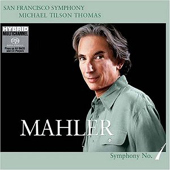
I believe the word 'vast' is an appropriate adjective to tag onto this imposing Gustav Mahler symphony. It is another example of orchestral wizardry, overflowing with fine instrumental details that even include parts for a guitar and a mandolin in the fourth movement. And again, Michael Tilson Thomas, the San Francisco Symphony players and the recording engineers have produced an impressive account of this work. All the fine orchestral details are in full evidence throughout, from the softest plucks on the harp to the loudest drum and cymbal crashes, the recorded sound is clear and full-bodied.
Tilson Thomas creates a solid momentum in the first movement, pushing along the main theme, one of those unmistakable Mahler themes full of menace and purpose. The dreamy 'moonlight' section in the middle of the movement is perfectly captured here and given a surreal atmosphere as if suspended in deep space.
The middle 'nightmare' movement, with its bassoon squawks, clarinet screeches, percussion snaps and trombone glissandi, is filled with shadows and wind rustlings under the conductor's lead, and the proper 'spook' effect is very well put across.
The two Nachtmusik movements are the definition of refinement, charm, elegance, with each and every instrument clearly defined. This is Mahler in 'simple beauty' mode, in a 'Viennese' sophistication mode, and the orchestra is wearing the appropriate dress.
Enough with sophistication, enough with delicate elegance, it is time to have fun. The final movement is exactly that. Too many musicologists and conductors have tried in vain to find a logic, to attach a meaning to this movement. It is simply Mahler flexing his orchestration muscle and having fun. He re-visits some of the ideas from all the previous segments and attempts to show us how they can all be manipulated to sound different. He changes the orchestration, switches instruments, alters rhythms, switches modes, etc... The sudden stops and abrupt changes in tempo are all part of the game. It's as if he is trying to fool us by playing that 'ball under the shells' game.
Now you hear it, now you don't. Mahler purposely avoids any sort of development. And obviously, Michael Tilson Thomas isn't searching for one. He and the orchestra are having too much fun. Now the 'Coup de Génie' comes right at the end. Remember the main theme from the first movement. The theme full of menace, restless, dark and in a minor key? Everytime I hear it I get the image from the famous painting 'The Ballad of Lenore', or 'The Dead Go Fast' by Horace Vernet. The painting portrays a corpse dressed in black riding a jet black horse at full galop. Well, to cap off this final movement, Mahler re-introduces this theme into the last few bars. But now it is in a major key and with a much broader tempo than before. It is the exact same music, but Mahler, by showing off his orchestration skills, has completely camouflaged and changed its emotional content. The image it now brings to mind is of an angel riding a white stallion above the clouds. It is an impressive feat. In fact, Dmitri
Shostakovich was so impressed that he did the exact same thing in his own 7th symphony, most likely as a tip of the hat to Mahler. It's in moments like this one that the sound engineering of this recording can really be appreciated for both its clarity and its punch!
This symphony is the point at which Gustav Mahler started down a new path. After having written works that dealt mostly with man's role within nature and the universe, his gaze turned inwards. He began reacting to outside stimuli on a more personal and emotional basis. Now 41 years old, he saw and understood his fellow men and society with a much more rational mind uncluttered by youthful ideals. This symphony is about oppression and the struggles to rid the world of its presence. That commanding trumpet call you hear introducing the first subject is the oppressor. The much softer and lamenting strings that follow, the second subject, are the oppressed complaining of their plight and begging for mercy. Michael Tilson Thomas makes a point of stressing the difference between the two subjects very well. What he lacks in this opening movement compared to the Bernstein/Vienna version, is that feeling of terror that sets in within the music as the movement progresses.
The second movement portrays the struggles and battles within these two opposing forces, with moments of frenetic and ferocious protest from the oppressed. The orchestration, and more specifically the percussion section, sometimes resemble the sound of distant bombardment. The following scherzo appears with a completely different attitude. Now it is all about how life was good in the past, all about great memories of youth, and about how the world should return to that state. The tone is now bright and the orchestration bolder. The SFS musicians dazzle in this movement, with each and every part clear, precise and bold.
What follows is this symphony's famous Adagietto played very well here by the SFS strings. At 10:49 it is slow, but I can think of two other famous accounts that are even slower. But in order to work its magic, this movement has to be slow. It is Mahler at his most vulnerable, touching and heartfelt. My take is that this music is an attempt to reconcile the world through love. Through a sense of brotherhood and common goal. After all, the last note of this movement is the catalyst from which the final movement launches into a dance that is passed along from instrument to instrument until it reaches the coda in full and frenzied joy.
This is by all means a tremendous account of this work, and again a wonderful recording. But the underlying character of the work is not reflected in the performance. The schizophrenic mind behind the music is lacking when compared to the above mentioned Bernstein version.
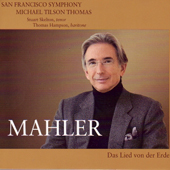
Maybe it's just me, but doesn't it seem like it was a long wait between the last installment in this prestigious Mahler cycle and this new release from September '08. Well, the old saying "good things come to those who wait" definitely applies to this remarkable recording. In fact, in this case the saying should be "amazing things come to those who wait".
This quasi-symphonic song cycle comprised of 6 songs based on Chinese poetry is one of Mahler's greatest efforts and definitely one of the greatest achievements in music. It's orchestration, full of intricate details and delicate moments, belies it's use of a large orchestra. Mahler's profound and ingenious adaptation of the poems about life and death on earth transcends time and space to create a touching experience for anyone listening. The final song, "Der Abschied" (Farewell), is of an ethereal and mysterious beauty, and heart-wrenching sadness as it expires at the very end.
Mahler indicated on the score, that this work could be performed by either a tenor and contralto, or a tenor and baritone. The famous tenor and contralto recording still remains, of course, the 1952 Bruno Walter version with the unmistakable voice of Kathleen Ferrier, which wrings every drop of emotion out of the last few moments of the final movement. That legendary recording left such an impression, that very few conductors have opted for the tenor and baritone version, fearing that the baritone voice would not be able to convey the same level of tender sadness as would a female voice.
Well, this captivating performance should allay those fears and settle that argument for good. Both Stuart Skelton and Thomas Hampson delve deep within themselves to deliver breathtaking readings of this poetry brought to life by Mahler's music. Their vocal inflections, tonal range, emphasis of key words and notes, even the way they pronounce certain words based on the sentiment within those words, all of that and more is done brilliantly during this live recording. Michael Tilson Thomas meanwhile, not only delivers one of the best orchestral renderings in this recording, but also provides one of the best supporting accompaniments ever given the two main actor/singers of this magical work. As usual, the recorded sound is demonstration class and up to the standards we have come to expect from San Francisco.
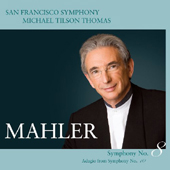
This final chapter in the San Francisco Symphony Orchestra's ongoing saga of the complete Gustav Mahler symphonies, which began eight years ago, brings to us the Symphony No. 8 in E-flat major, (Symphony of a Thousand). The stunning photograph inside the CD booklet gives us an idea as to why it goes by that name. Also included, is a recording of the Adagio from Symphony No. 10, the last completed symphonic fragment by Mahler.
The CD opens with the Adagio. A harmonically forward looking work, breaking new ground with adventurous leaps of the imagination. It's unfortunate that we are not given the complete symphony, but some conductors prefer to stick to the one movement that Mahler had fully noted and orchestrated before he died. Michael Tilson Thomas definitely sees this work as a 20th century creation, turning its back on tradition and taking a bold step forward. Under this conductor's view, the new harmonic leaps and unusual intervals seem more modern than most conductor's would have you believe.
The first few opening bars, scored only for the violas, that whole opening sequence is a question. It is Mahler asking a profound question. The violas are probing in the darkness, tentatively seeking an answer, seeking the light, searching for a key. The orchestra answers, at first quietly and innocently. But the violas never seem satisfied with the answer and keep repeating the question, prompting the orchestra to respond more and more aggressively. Then, near the middle of the movement, the violas again ask the question, this time with more impatience, and this time actually add a note one semitone up to their question at the 19:08 mark. The orchestra does not like the violas impudence and bears down on them with full force, suffocating the music with its dissonance, and emphatically warns them to stop seeking answers to the riddles of life. By this time the harmonic fabric of the music has become very dense and complex, but gradually, everything calms down and the music slowly seems to decompose itself
and becomes simpler and simpler, reverting backwards harmonically to the simplest structure possible. And that is when the light appears. That is when the answer to the question is finally revealed. At 26:42, a massive, glorious chord is brilliantly laid out, ever so gently, layer by layer, until we hear the infinity of the universe within it, and the music can now finally come to a peaceful resolution. Another Coup de Génie by Gustav Mahler.
All of the above is perfectly in evidence and then some, under the firm control of Michael Tilson Thomas and delivered with demonstration class sound.
Symphony No. 8 tips the scales at the other end of the spectrum. It is a work bursting with energy, full of light and joy. As I have mentioned before, it is miraculous how so few notes on a piece of paper, when well organized, can climb such emotional heights. The forces involved in this creation are enormous. A full, enlarged orchestra, a pipe organ, eight singers, a boys choir, a girls choir, and a full mixed choir.
In this recording the sopranos are Laura Claycomb, Elza van den Heever, Erin Wall, the mezzo-sopranos are Katarina Karnéus, Yvonne Naef, the tenor is Anthony Dean Griffey and the baritone and bass-baritone are Quinn Kelsey and James Morris. They are surrounded by the San Francisco Symphony Chorus, the Pacific Boychoir and San Francisco Girls Chorus. Everyone involved in this project sings with gusto, élan and a sense of excitement and circumstance. The sopranos in particular soar high and clear over the ocean of sounds put forth by all the tremendous forces involved. The first section of the symphony, the Veni Creator Spiritus leaps out at you, and never lets up in energy, joy and sense of occasion. From the first organ pedal note to the final full choral walls of sound, this performance never lets up. Michael Tilson Thomas knows that the creator of this work is also the best orchestrator, and balances everything so well that the orchestra and choirs become one, with each and every
individual parts, in all of their glorious counterpoint and interactions, merge perfectly together to form one entity. All the intricate details are so well captured that they mysteriously become invisible within the grand sheme of things.
The second half of this work, the Final Scene from Goethe's Faust begins quietly, with one of Mahler's most inspired orchestral passages, and after a while the choir mysteriously joins in to create some amazing textural moments of brilliant harmony. Very gradually the text unfolds and singer after singer join in representing different celestial characters, with the movement slowly unfolding to become an orgy of uplifting and stupendous sound carrying us aloft.
The recorded sound here is simply amazing. Too often this symphony has suffered from poor recordings that would just simply crumble under its weight, and sound terribly congested and turn to mush at all the crucial moments. Not this recording. Even in the most powerful and maximum tuttis, the sound is clear, bright, full and round, and will thrill musicians and audiophiles alike. A supreme achievement on all counts. Congratulations to all involved and sincere gratitude to Michael Tilson Thomas for making this Symphony of a Thousand a crowning capstone to a distinguished and world class Mahler symphony cycle.
Addendum At the January 31/2010 Grammy Awards ceremonies, this recording performed a hat trick by winning 3 of
the main categories. It received awards for Best Classical Album, Best Engineered Album and Best Choral Album. It definitely deserves them all, and
over time more awards will certainly gravitate to it.
Now that the dust has cleared from the impact created by the tremendous recording of the Symphony No. 8 by Gustav Mahler, and by the complete
symphonic cycle for that matter, a cycle that was almost 10 years in the making, Michael Tilson Thomas and the San Francisco Symphony
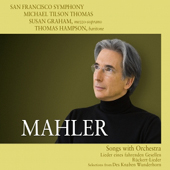
Orchestra now release the final disc of this impressive series of award winning recordings. This time around the focus is on the Songs with Orchestra,
songs from which most of the basic thematic material of the symphonies is taken. These songs contained all the fertile imagery and pregnant ideas on which Mahler
established his massive symphonies. The Lieder Eines Fahrenden Gesellen were recorded live in September 2009 with baritone Thomas
Hampson. Selections from Des Knaben Wunderhorn, also with Thomas Hampson, were captured during a live concert in May 2007.
The Rückert-Lieder were recorded live, also in September 2009 with mezzo-soprano Susan Graham.
My immediate attention, on listening to this CD for the first time, was drawn to the wonderful Rückert-Lieder from 1901, and in particular to the
Ich bin der Welt abhanden gekommen (I am Lost to the World) song. This is Mahler doing what he does best, writing music around the
subject of loss, death, the beyond. And of course I had to pull out my copy of the iconic recording on EMI with Janet Baker and Sir John Barbirolli from 1969 to have
something solid of a yardstick to compare against. I must say that even though Baker's voice conveys the poem's deeper sense of sadness, Susan Graham's beauty of
tone and overall delivery fits Mahler's view of this poem even better. Everything after the 4:00 point is pure magic here. Listen to how Graham's voice and the
orchestra have become one, how the beautifully lush strings hold the voice aloft during the high soft notes. Notice also, after the singing ends, how this orchestra brings
out all of the beauty within Mahler's orchestral writing. Defining the orchestral textures and strands has been one of this conductor's finer points throughout this whole
cycle.
And of course, Thomas Hampson's strong devotion to this music, as in his formidable interpretation of 'Das Lied von der Erde' in a previous release
during this cycle, is very much apparent in his approach to the Lieder Eines Fahrenden Gesellen and the Des Knaben Wunderhorn.
It is hard to believe that a baritone voice could display so many colors or convey so many emotions this well. And what better way to end a glorious Mahler cycle than
with a deeply felt and vocally beautiful version of Des Knaben Wunderhorn's Urlicht, the same setting usually sung by a female voice in
Mahler's Second Symphony, now captured and portrayed even better by Thomas Hampson's warm baritone voice.
It goes without saying that Michael Tilson Thomas and the San Francisco Symphony Orchestra players have once again delivered
the goods. I would even say that this has become a top Mahler orchestra, with a beauty of sound rarely matched and an old-school perception and conception of the
world given us by Mahler. Bravo!!!
The Mahler phenomenon has absorbed rivers of ink and the foregoing represent a few fragments of the extensive literature devoted to the composer. All of it is
meaningless without regular immersion in the music and for most it is recordings which illuminate the path to knowledge and understanding of Mahler. Michael Tilson
Thomas brings the scores to life and with a very personal alchemy succeeds in extracting new gold from well-trodden furrows.
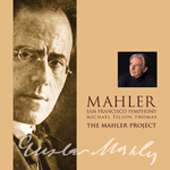
The San Francisco Symphony's Mahler Project began on a fateful day-after in 2001 and is now complete and boxed up to celebrate the 100th anniversary of the
composer's assumption of the 'heavenly life'. It is the most generous Mahler collection ever offered on compact disc.
The previously issued albums have been reviewed in detail on this site by Jean-Yves Duperron and appear in order of release date in the "Overviews" section. After
careful listening and numerous comparisons, this critic can but ardently second Mr. Duperron's resounding endorsements. These performances (seven-time Grammy
winners) are outstanding with engineering of commensurate quality. This is an unparalleled achievement; not simply an excellent Mahler cycle, but of and in itself an
era in Mahler interpretation.
To cycle or not: Norman Lebrecht contends that, "No conductor has all the answers in Mahler, and no boxed cycle by a single
interpreter will satisfy the questing mind." Two decades ago record critics would have supported this opinion. Collectors were advised to choose the best available
individual performances (for example, No1: Kubelik; No 2: Rattle; No 3: Horenstein; No 4: Szell; No 5: Bernstein; No 6: von Karajan; No 7: Abbado; No 8: Tennstedt;
No 9: von Karajan; No 10: Chailly). Those recommendations remain gospel for some but, since the turn of the century, some integral symphony cycles have emerged
which make a strong case for single-point consistency with respect to interpretation. The long overdue re-issue of Gary Bertini's Cologne cycle (EMI) and the more
recent SWRSO box under Michael Gielen (Hänssler) furnish ample proof. The Amsterdam cycle conducted by Riccardo Chailly (Decca) also demonstrates that the whole
can exceed the sum of the parts. Mahler reputations of the future may depend on a conductor's desire and ability to go the whole nine (or ten) yards. By this
demanding criterion, Michael Tilson Thomas must be recognized as a master of Mahler's works.
Which Super Audio cycle? As it happened, a comparative Mahler cycle in Hybrid SACD format came to hand with the same North
American release date. From RCA, David Zinman conducts the Tonhalle Orchestra Zurich in a 15 disc/1 DVD set. Both issues feature presentation and packaging of
artistic merit. Indeed, respective producers are fully aware of what is important to true record collectors and the visual/tangible elements amount to a dual grand
remonstrance against the sack cloth and ashes of downloading. Across the board, these sets represent the distillation of luxury goods into one of the necessities of life.
The music of Gustav Mahler spans a full spectrum of interpretation. On the emphatic-romantic side rests the recorded legacy of Leonard Bernstein. At the other extreme
are the objective readings of Pierre Boulez and the characterization of Mahler as a modernist. Tilson Thomas nailed his colours to the mast with the first performance of
the project released (of Symphony No 6, recorded 12 September 2001) and revealed his admiration for Lenny's manner in this music (but without significant distention
of tempos and dynamics). For those whose first acquaintance with the composer came from LB, this is like viewing a familiar landscape after distracting billboards had
been removed. MTT can generate the same level of emotional tension as Bernstein did while avoiding exaggeration. The accounts of Symphonies 4, 8 and 9 presented
here are better than anything that Lenny left us on disc.
Like Gielen, Zinman pursues a more central axis with elements of almost classical refinement. Respective orchestral playing and playback in super audio surround or
stereo and conventional CD mode are comparable (and excellent). If a choice must be made it should be based on preference for the style and specific contents of the
boxes. Michael Tilson Thomas places the same importance on Mahler's songs as the composer did himself. His collection is more extensive with three discs of vocal
works and the first time release of Rückert-lieder for piano and voice with MTT accompanying Susan Graham. While Zinman tackled the Carpenter
'completion' of the Tenth, Tilson Thomas limits himself to the completed adagio.
So it is Zinman's fifteen discs of well-mannered Mahler against the Tilson Thomas box of seventeen rather less buttoned-down performances. These sets can be
recommended to both seasoned collectors and novices. Die-hard Mahlerians will need the pair.
David Zinman does have an ace up his sleeve in the form of Viviane Blumenschein's documentary film, Going against Fate. The 80-minute DVD is included
in the RCA box. It is constructed around rehearsals, performance and recording of the Sixth Symphony in Zurich. It is a most worthwhile production, not least for the
conductor's lusty rendition of Tom Lehrer's rude song, Alma.
Keeping Score: It is also possible to get a good look at the magnificent San Francisco orchestra in the double DVD release of
Mahler, Origins and Legacy, a documentary prepared for broadcast on PBS. Total timing for the set is 227 minutes. The documentary appears on the first DVD.
It consists of an on-screen, on-location narrative by Michael Tilson Thomas as he retraces the composer's footsteps through Central Europe in a very impressive
travelogue. MTT is a gifted communicator. He blends native California ease with old-style East Coast intellect to address a wide audience spectrum which will reinforce
old Mahlerians and recruit new ones. The documentary features numerous musical illustrations from concert performances and detailed analysis of some works and
highlights from others. The second DVD offers a complete performance of the First Symphony and excerpts from Nos 5, 7 and 9 along with selections from Songs
of a Wayfarer with the redoubtable Thomas Hampson as vocal soloist. These films are a valuable adjunct to the audio box and worth the modest additional cost.
Pinching Pennies: The Mahler Project is a considerable bargain for 17 discs. It may be ordered here or from The San
Francisco Symphony Store (sfsymphony.org/shop). Purchases made from the
Symphony Store support the music and education programmes of the SFS. And let us give thanks to the orchestra's generous patrons including the philanthropist
composer, Gordon Getty who made these recordings possible. SFSmedia was the first orchestra-based record label in the US. The Mahler Project is ample proof that the
San Franciscans under Michael Tilson Thomas continue to demonstrate consummate leadership in the realm of musical culture.




 HOME
HOME