Reviews of Performing Artists
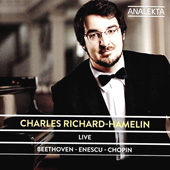
CHARLES
RICHARD-HAMELIN
Beethoven/Enescu/Chopin
Analekta AN29129
774204912925
Released: October 2016
Buy from AmazonCHARLES RICHARD-HAMELIN
Plays Beethoven, Enescu and Chopin
Ludwig van Beethoven - Two Rondos for piano, Op. 51
George Enescu - Suite No. 2 for piano, Op. 10
Frédéric Chopin
- Ballade No. 3 in A-flat major, Op. 47
- Nocturne in E-flat major, Op. 55, No. 2
- Introduction and Rondo in E-flat major, Op. 16
- Polonaise No. 6 in A-flat major "Heroic", Op. 53
As I had pointed out previously in this review of Charles Richard-Hamelin's amazing all Chopin
recording, this Canadian pianist certainly has a way of enhancing a musical composition without inflicting too much of his own mannerisms and idiosyncrasies on the music's discourse in quite
a remarkable way. And not only that, but as displayed on this new 'live' recording featuring three deeply contrasting composers, he can quickly and easily switch stylistic hats from one composer
to the next without leaving any traces behind. By this I mean that his Beethoven is steadfastly classical, his Enescu colorfully modern, and his Chopin deeply romantic, without any interpretive
colors bleeding from one to the other. Something which again demonstrates that he's a master musician that can perform any musical work at face value, or as intended by the composer, without
imposing his own conceptions on it. The notes printed on the score vanish, the awesome technique involved fades away, the weeks of rehearsals are forgotten, and he simply delivers the essence
of the music at hand. What more is there to say .... He brings to mind the 20th century greats that pioneered these masterpieces on the concert stage!
Jean-Yves Duperron - November 2016
Back to top
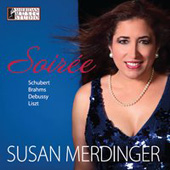
SUSAN MERDINGER
Plays Schubert, Brahms
Debussy and Liszt
Sheridan Music Studio
888295134347
Released: July 2014
Buy from AmazonSUSAN MERDINGER
Plays Schubert, Brahms, Debussy and Liszt
1} Franz Schubert: Sonata in B major, D. 575, Op. 147
2} Johannes Brahms: Rhapsody in B minor, Op. 79 No. 1
3} Johannes Brahms: Rhapsody in G minor, Op. 79 No. 2
4} Claude Debussy: Pagodes
5} Claude Debussy: La Soirée dans Grenade
6} Claude Debussy: Jardins sous la Pluie
7} Franz Liszt: Concert Paraphrase on Verdi's "Rigoletto"
8} Franz Liszt: Hungarian Rhapsody No. 12 in C-sharp minor
Although I've never seen pianist Susan Merdinger performing 'live' on stage, upon listening to this CD for the first time, I couldn't help but
visualize a very animated on stage presence - punctuated head gestures, hands flailing in the air, eyes shut with an air of impudence - you know the type.
Curiosity got the better of me, so immediately following my initial listening session, I watched a couple of video clips of her performing on stage in front of a live
audience, and her stage behavior is actually the complete opposite of what I had imagined. It's just that her playing, regardless of the composer, is always so deeply
expressive, so strongly animated and driven forward by the power of the music itself, that she doesn't need extraneous body gestures to convince anyone of the
music's inherent power and her ability to channel it to the listener.
For example, certain passages within the Brahms Rhapsodies reach levels of expressive passion that border on the aggressive, but quite appropriately so, and never
simply for showmanship. Her Debussy is always airy and precise, never cloudy. Her Liszt is virtuosic, refined and statuesque all at once. She always seems to know
exactly how much emotional weight to give each and every phrase. It's as if she doesn't just play the notes, but actually analyses each one's involvement in the
chain of events before playing it, all done on the fly. Best of all is that the quality behind her interpretations seems spontaneous and instinctive, and never fabricated.
Jean-Yves Duperron - September 2014
Back to top
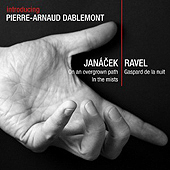
PIERRE-ARNAUD
DABLEMONT
Plays Janácek and Ravel
On an overgrown path
Gaspard de la nuit
PAD 1206001
Released: July 2012
Buy from AmazonPIERRE-ARNAUD DABLEMONT
Plays Janácek and Ravel
Pianist Pierre-Arnaud Dablemont has chosen, for the release of his first recording, to adopt an unusual business model and an altruistic
approach concerning the direct-to-consumer distribution of his new CD. It's a courageous undertaking when you consider the present level of market saturation, and
the fact that by making his recording freely available to anyone who wishes to download it, has the potential to expose his technique and interpretation to a higher
number of critical ears. And he's chosen to launch his recording career performing some rather difficult material. But when you play this well, what's there to worry about.
All three works presented on this recording, the On an overgrown path and In the mists by
Leos Janácek, and more so the Gaspard de la nuit by Maurice Ravel, are piano pieces that transcend the
instrument, that negate their technical and theoretical construct, and are borne out of pure imagination and therefore need to be expressed as pure imagination. The
interpreter needs to look beyond the score and pare the music down to its essence and expose its catalyst. And that is precisely what Pierre-Arnaud Dablemont
achieves in this, his own private production. The miniature snapshots of life that constitute the Janácek, sort of like Grieg's Lyric Pieces, amuse by their honest simplicity
of emotion, and are perceived and performed as such. The new harmonic explorations of In the mists come well to the fore in this recording.
Still considered one of the most technically demanding works ever written for piano, Gaspard de la nuit would suffer badly from a
purely technical approach. This music feeds on its emotional impetus and can easily die when starved of this stimulus. Dablemont does such a wonderful job of this,
that in Le gibet for example, the instrument fades away and you are bewitched by the music alone.
For more detailed information on this project or personal views on the music, please visit Dablemont's website
by clicking here. The future of
classical music is obviously in good hands.
Jean-Yves Duperron - August 2012
Back to top
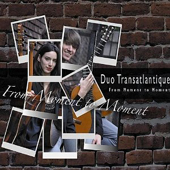
DUO TRANSATLANTIQUE
From Moment to Moment
Maud Laforest (Guitar)
Benjamin Beirs (Guitar)
B004Y6CTCS
Released: April 2011
Buy from AmazonDUO TRANSATLANTIQUE
From Moment to Moment
Guitar fans take note. The classical guitar duo of Maud Laforest and Benjamin Beirs, collectively known as the
Duo Transatlantique,
are a couple of young guitarists to watch and follow. They have been working together now for close to 10 years, and on this their second recording, they exhibit a
mastery of the instrument well beyond their years. The versatility in their playing is reflected in the variety and different styles of pieces on this CD.
1 - Paulo Bellinati: Jongo
2 - Antoine de L'Hoyer : Duo No. 1, Op. 31
3 - César Franck: Prelude, Fugue and Variation Op. 18
4 - Domenico Scarlatti: Sonata K. 234
5 - Domenico Scarlatti: Sonata K. 115
6 - Eric Penicaud: Little Suite for Children
7 - Yann Tiersen: Three Pieces from the film "Amélie"
8 - Scott Joplin: Maple Leaf Rag
9 - Scott Joplin: Cleopha
And by versatility, I mean the flexible expressive approach and playing techniques they bring to every different piece, from the Baroque clarity of the Scarlatti, to the
simple fun of the Joplin, and the melancholy of the Tiersen which by the way is performed here in a superb arrangement for two guitars by Maud Laforest herself. The
suite of pieces by Eric Penicaud, dedicated to this duo, is also a great example of how guitar strings, when played by skilled musicians, can be made to sound like nylon, steel or even glass,
from one moment to the next. They also demonstrate pinpoint timing and an innate sense of proportion and balance between the two instruments.
While both studying in Baltimore, they decided to start performing as a duo, but eventually one moved to France while the other stayed in the United States, hence
the logic behind their professional name. But yet they continue to perform and tour together as an ensemble, regardless of the distance and time constraints. Further
proof of their dedication and devotion to music, qualities immediately apparent in their playing. The recorded sound is clean and intimate, and focuses our attention on
the quality of sound these two instruments produce.
Jean-Yves Duperron - June 2011
Back to top
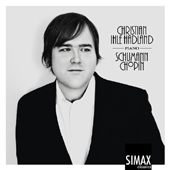
CHRISTIAN IHLE
HADLAND
Plays Chopin
and Schumann
Simax PSC1307
7033662013074
Released: October 2010
Buy from AmazonCHRISTIAN IHLE HADLAND
Plays Chopin and Schumann
In this, his first solo piano recording, and hopefully the first of many, Norwegian pianist Christian Ihle Hadland presents lesser performed, but yet
significant works by Chopin and Schumann. There is an ease, an elegance, in his delivery that belies his young age. Nothing sounds like its been toiled or worked over.
The emotional sentiments within the music are never labored or done for effect, but rather seem to simply pour out from his mind to his fingers, with no sign of
resistance or artificiality.
FREDERIC CHOPIN
- Impromptu in A flat Major, Op. 29
- Trois Nouvelles Etudes
- Impromptu in F sharp Major, Op. 36
- Impromptu in G flat Major, Op. 51
- Rondeau, Op. 16
ROBERT SCHUMANN
- Blumenstück, Op. 19
- Waldszenen, Op. 82
For example, in order to be effective, the Schumann Waldszenen require a delicacy, a discreetness of emotion and a subtle sense of humor. Christian Ihle Hadland
delivers on all counts and even seems to find more within the music than what lies on the surface. The "Vogel als Prophet" for example, benefits from a
very thoughtful and probing interpretation.
The Simax recording captures all of the nuanced subtleties of the performer's touch, in a very natural acoustic that reveals the music and nothing
more. If you are a piano buff, don't miss out on what is shaping up to be the launch of an exciting and revelatory recording career.
Jean-Yves Duperron - January 2011
Back to top
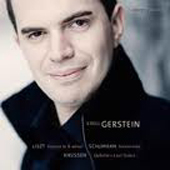
KIRILL GERSTEIN
Plays Liszt, Schumann
and Knussen
Myrios Classics MYR005
4260183510055
Released: November 2010
Buy from AmazonKIRILL GERSTEIN
Plays Liszt, Schumann and Knussen
When Kirill Gerstein's previous solo piano recording was released a few years back on the Oehms label, it immediately grabbed my attention and
focused my critical ear on this pianist's versatility and facility at getting under a composer's skin. Amongst other pieces on that CD I was impressed by the clean articulation
and directness of his Bach, and the combination of lyricism and grand gestures he brought to the music of Scriabin.
A few years onward, and now on the Myrios Classics label, the same level of artistic integrity and musical elocution is ever present. The CD opens with
the Humoresque Op. 20 by Robert Schumann. A large work full of emotional twists and turns delivered with all the
desired emphasis on tension and release, harmonic poetry and technical runs, and all the various emotional states well defined by a well proportioned multi-layered use
of dynamics.
Here given its world premiere, Ophelia's Last Dance, Op. 32 by composer/conductor Oliver Knussen, was actually
a work commissioned by the Gilmore International Keyboard Festival for 2010 Gilmore Artist Award recipient Kirill Gerstein. It is a very atmospheric piece that I would best
describe as a Debussy tinged creation with a slight scent of Satie, and the slightest of 21st century jazz undercurrents. In any case, the dedicatee of the work certainly
makes it his own by breathing life into this new composition, immediately and magically making it sound like an old favorite, as it oddly enough seems to stir memories
of music from a familiar past era. It is also very effective, in the way it ends, at imparting the idea of someone's last dance.
The CD concludes with the monumental Sonata in B minor by Franz Liszt. A long single-movement work divided
into four continuous segments all driven by the same idée fixe, made up of a myriad of subtle variations and modifications of the main opening motif. Some
of these developments build to awesome levels of power, where some pianists become ham fisted and loud for the sake of being loud, but Kirill Gerstein ascends these
dynamic peaks by creating a quasi-orchestral effect and by turning all those notes into a 'power in numbers' game. His playing delivers a seamless narrative from start
to finish that is impressive in its many subtleties and different shades of the same color.
This is without a doubt a pianist that I intend to follow closely, because I am curious to see how he can possibly get any better than this!
Jean-Yves Duperron - December 2010
Back to top
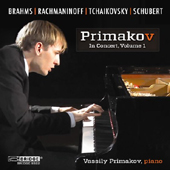
VASSILY PRIMAKOV
In Concert, Volume 1
Recitals 2002-2007
Bridge 9322
090404932229
Released: Nov 2010
Buy from AmazonVASSILY PRIMAKOV
In Concert, Volume 1
Those of you who have been following pianist Vassily Primakov through his many fine studio recordings, will be glad to hear that all this time Bridge
Records have been busy tracking and recording his 'live' recitals, and this new CD is the first in a series of overviews of these concert performances. It presents
a broad variety of works that highlight Primakov's multi-layered interpretive skills.
Brahms: Two Chorale Preludes, Op. 122, Nos. 9 and 10
(transcribed for piano by Ferruccio Busoni)
Schubert: "Wanderer" Fantasie, Op. 15 (D. 760)
Tchaikovsky: Album pour enfants, Op. 39
Rachmaninov: Sonata No. 2 in B-flat minor, Op. 36
The Schubert, recorded in 2002 when Primakov was only 21 years old, is at times profound and at times full of impetus and power, so much so that I'm surprised the piano
was still standing at the end. The Tchaikovsky, from a New York recital in 2006, a suite of pieces very much like Schumann's 'Scenes from Childhood', is given as much
thoughtful consideration as if it was a grand scale work. The Rachmaninov Sonata, performed here in its 1931 revision rather than the usual 1940 Horowitz edition, is full
of color, emotion and depth of expression, and the final movement's orchestral undertones are pushed to their limit and the whole thing is driven to a stupendous conclusion.
For me, the revelation on this disc turns out to be the Brahms Chorale Preludes. Works originally written for the organ but played here in their Busoni piano transcriptions.
Composed late in life, and described by Primakov himself as being full of "ominous finality", they nonetheless glow with a deep beauty and the wisdom that
nothing more can be said that isn't already within this music. Primakov plays them with just the right balance of pathos and warmth.
This recording is therefore indispensable as a guide through the memorable moments of this young pianist's mercurial career. It not only shows where he's been musically,
but also where he's headed. It's the start of a series of treasure filled recordings.
Jean-Yves Duperron - December 2010
Back to top
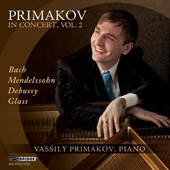
VASSILY PRIMAKOV
In Concert, Volume 2
Recitals 2005-2008
Bridge 9350
090404935022
Released: Oct 2011
Buy from AmazonVASSILY PRIMAKOV
In Concert, Volume 2
Bridge Records serve up a second helping of pianist Vassily Primakov captured live during various recitals over a span of three
years. As in the first volume (Bridge 9322), it well displays this pianist's multi-layered interpretive talents covering styles and technical demands as diverse as the day
is long.
Mendelssohn: Songs without Words, Book 2
Bach: Suite No. 2 in C minor, BWV 813
Glass: Suite from "The Hours"
Debussy: Suite Bergamasque
From one composer to the next he is able to, not unlike a talented impersonator, get into character and have one believe that he is in fact that composer. The quasi
Schubertian simple beauty of Mendelssohn's melodic ideas come through clearly. The finesse of Bach's counterpoint, the dance character of the Suite's inner movements,
the beautiful melancholy of the Sarabande, all these and more are constantly present in his playing. Debussy's pointed, saltimbanco style is well defined here, and Primakov
can say so much with even the lightest touch, and like a street acrobat, can bounce up and down the keyboard effortlessly. His look at the famous Clair de lune
is free of the self-conscious, Hollywood-influenced, exaggerated mannerisms inflicted on it by so many other performers, and simply shimmers and glows from within as
it should. But most impressive of all, is what Vassily Primakov brings to the music of Philip Glass. Most musicians expose the obvious traits of this composer's style, the
repetitive patterns, the minimalist techniques, the sequential loops, the steady rhythmic pulse, etc ... Primakov finds a beating heart behind all this, and if the mood of the
piece begs for it, applies as much expression to it as if it were a Chopin Nocturne.
Everytime I listen to piano music performed by Vassily Primakov, I can't help but hear and feel a living force behind the notes, not just playing the music but re-creating
it. And isn't that exactly what every musical masterpiece deserves, and what we the listeners should always expect.
Jean-Yves Duperron - December 2011
Back to top
DISTRICT 97
Hybrid Child
Laser's Edge LE1057
763232105720
Rel: September 2010
Buy from AmazonDISTRICT 97
Hybrid Child
I know! I know! This is not classical music. But let me explain.
If you are like me and of about the same age, you most likely have a few Progressive Rock ghosts or skeletons in your closet. I am sure that during the 1970's you went
through a phase or period of heavy Prog Rock listening and discovery, enjoying that distinctive blend and merging together of loud electric rock instruments and the large
scale structure, discipline and epic scope of classical music. Some bands even managed to convert pop heads to classical by playing and recording fascinating adaptations
and energized arrangements of standard classical works. I myself always respected these "rockers" for their top-notch musicianship. Emerson, Fripp, Zappa, to name only
a few, would be considered virtuosos if they were classical musicians.
Well along comes District 97. Considered Chicago's foremost Progressive Rock band, and featuring as one of their members the Chicago
Symphony Orchestra's virtuoso cellist Katinka Kleijn, they deliver a sound very reminiscent of that era along with a mix of today's edge
and punchy vocals. Their writing skills are keen, their musicianship is sharp. A great example of that is the piece titled 'Mindscan VII: Exploration'.
And of course, this is all very suggestive, so don't just take my word for it. If you like the music of Olivier Messiaen, click
here to listen to District 97
's amazing adaptation of his "Quartet for the End of Time: Dance of Fury, for the Seven Trumpets". Unfortunately, it was intended
to be part of the lineup of cuts on Hybrid Child, but the Messiaen Estate would not permit its commercial release. So do visit the above link to get a
strong taste of the band, and to experience flashbacks from your days as a head-banger.
ClassiRock On!!!
Jean-Yves Duperron - September 2010
Back to top
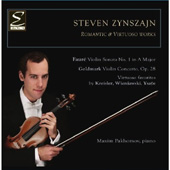
STEVEN ZYNSZAJN
Romantic & Virtuoso Works
Steven Zynszajn (Violin)
Maxim Pakhomov (Piano)
Eroica 3446
714548344624
Buy from AmazonSTEVEN ZYNSZAJN
Romantic & Virtuoso Works
At a time when the economy in general is at a low point, and when, according to certain claims which I do not support, the classical recording industry is in turmoil, you
would think that young people would think twice before starting out as classical musicians, or that people close to them would do their best to discourage them from
travelling down that winding path. But then there would be no one in front to grab the baton in the never ending relay race of music performance. Well, thankfully, there
are brave and talented musicians, like STEVEN ZYNSZAJN who
are willing and commited to take on that daunting challenge. And we are all the better for it.
With someone like Steven Zynszajn participating in this relay race, we know that we stand a good chance of winning in the end. His technique is
rock solid, his musicianship is mature, but its the way in which he seems to instictively know just how much emotional emphasis to apply to every note that captured my
admiration. There is no better example of that then in the way he plays the Fritz Kreisler Recitativo and Scherzo for Solo Violin, Op. 6. A perfect blend
of technique and emotion. Notice in particular the wonderful way he delivers that very high soft note at the 3:15 mark. The rest of the program is varied and interpreted
with the same care and confidence, all with the capable hands of Maxim Pakhomov providing the piano accompaniment. The Violin Sonata
No. 1, Op. 13 by Gabriel Fauré, a violin and piano reduction of the first movement of the Violin Concerto in A minor, Op. 28
by Karl Goldmark, Rêve d'Enfant, Op. 14 by Eugene Ysaye and the Variations on an Original Theme,
Op. 15 written by Henryk Wieniawski. All works for the violin that impose great technical demands on the player, as well as interpretive ones.
There is no point playing a virtuoso showpiece if you can't project the emotional impetus behind it. And that is what Steven Zynszajn achieves every
time.
The fine violin used in this recording is an 18th century Cremonese instrument built by Aegidius Barzellini. It is endowed with a deep and dusky voice with wonderfully
sweet notes in the high register. Very well suited to these pieces and to Zynszajn's delivery. The sound recording is a bit unusual. It sounds as if you are standing at the
back of a large and empty auditorium, with the violinist at the edge of the stage and the pianist in the back somewhere behind thick and wooly curtains. In other words,
the recording could have used a bit more clarity and closer microphone placement. But the playing is so good that you quickly adjust to the sound and are no longer
distracted by it. Recommended listening for all violinists and collectors of music by these composers. For more detailed information on this violinist, simply click on his
name above highlighted in yellow. It will link you directly to his own website.
Jean-Yves Duperron
Back to top
SMARO GREGORIADOU
Reinventing Guitar!
All of you music collectors out there that have only one guitar CD on your shelves because you think all guitar recordings sound the same, re-organize your collection
to make room for one more because now you will have two guitar CDs on your shelves. This recording by the Greek guitarist and composer
Smaro Gregoriadou, as its title
'Reinventing Guitar!' suggests, opens up a whole new sound world in the realm of this humble instrument.
I myself am an organist and pianist, and therefore will not try to explain or transmit to you the technical and musical aspects involved in the making of this recording.
Suffice it to say that the CD booklet notes accomplish that very well with detailed musical and even scientific data, stunning photographs of the wonderful instruments
built by guitar-maker Yorgos Kertsopoulos, and detailed information as to Smaro Gregoriadou's interpretive approach to every
piece on this CD. And if that was not enough, when you click on the performer's name highlighted above, you will be directed to her own website full of even more
detailed information on the instruments, the music, and the raison d'être behind the recording and lots more. Very interesting and informative stuff!
The fact that Smaro Gregoriadou is a world class guitarist and musician is immediately obvious and clear. She approaches each work from a different musical angle, so to
speak, based on its style, time period and origin. For example, her interpretation of the Bach Lute Suite BWV 995 is straight Baroque, in fact played
with a guitar that sounds like a cross between a lute and a harpsichord. This is the world premiere recording of this amazing instrument, a triple-double-single course
guitar in re-entrant tuning. And then of course, her reading of the Antonio José Sonata para guitarra, written in 1933, is true to the style and times
in which it was composed, and this time it is played on a classical guitar with metallonylon trebles. What I found remarkable about the new instruments used in this
recording, is the way they allow for a much more detailed separation of the treble and bass voices, of the different musical lines within each piece. One guitar almost
sounds like two separate instruments. A guitar with scalloped frets and a movable back is featured in a piece by Scarlatti. There is also one work by
the guitar-maker himself Yorgos Kertsopoulos, and two Balkan Dances by Smaro Gregoriadou herself that,
the first one in particular, would require hours upon hours of practice for any guitarist to master.
A fascinating CD for any classical music enthusiasts, and a definite must-have for any serious classical guitar fans. The excellent Delos recording
does not try to manipulate the sound in any way. It delivers the natural and attention grabbing sound of these wonderful guitars in a clear and open ambience.
Jean-Yves Duperron - June 2010
Back to top
SMARO GREGORIADOU
Reinventing Guitar II
Delos 3419
013491341927
Buy from AmazonSMARO GREGORIADOU
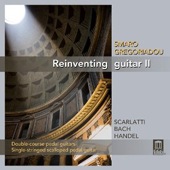
Reinventing Guitar II
1} Domenico Scarlatti - 5 Harpsichord Sonatas
2} Johann Sebastian Bach - Prelude, Fugue and Allegro in E-flat major, BWV 998
3} Johann Sebastian Bach - Toccata in E minor, BWV 914
4} George Frideric Handel - Air and Variations "The Harmonious Blacksmith"
5} George Frideric Handel - Chaconne No. 2 in G major, HWV 435
6} Analytical presentation of all tunings
In my previous review of guitarist Smaro Gregoriadou's first CD titled Reinventing Guitar,
I may have given the impression that the sound quality of the various instruments at her disposal was the key factor which made that recording so enjoyable. True, the
wonderful instruments built by guitar-maker Yorgos Kertsopoulos, played on her first CD and again on her new recording Reinventing Guitar II,
certainly deserve praise, but in the end, it's Gregoriadou's amazing musicianship that brings these guitars to life.
One phrase from her own liner notes which caught my attention is as follows: "Bach spoke often of the performance of a piece as requiring gravitas. The effort to reveal,
and - if possible - transmit the energy of this inherent spirituality through interpretations rooted in the mother sonorities is the essence of my approach." She finds
and uses each guitar's unique nature to project the music's character and purpose. The clarity and separation of each musical line and the perfect dynamic balance of
the counterpoint under her fingers are uncanny. Her musical approach to each individual composer is tailored to each one's style. Under her fingers Scarlatti is spirited,
Handel is noble, and Bach is fluid. Her technique is so solid that it doesn't even factor into the big picture. All the pieces on this CD were arranged by Gregoriadou herself
for double-course pedal guitar or single-stringed scalloped pedal guitar, and she did not try to cover-up any difficulties inherent to the music in her transcriptions. Some
of the fingering work she does would make lesser guitarists cry for mercy. Some of these works are hard to play in their original versions, with both hands in front of
you on the keyboard, therefore they must be a tremendous challenge on a fretted instrument, but Gregoriadou makes it all seem so easy. The musical lines flow naturally,
even in the thorniest passages. All the embellishments, trills and double mordents are present, true to the baroque style, and at times you could swear that you are listening
to a harpsichord.
The CD includes a bonus track on which, through the use of examples, Smaro Gregoriadou herself explains the characteristics of the different types
of strings and guitars used for this wonderful recording. Highly recommended for all guitar enthusiasts and baroque music fans alike.
Jean-Yves Duperron - August 2012
Back to top
JOEL FAN
West of the Sun
Music of the Americas
Reference 119
030911111922
Buy from AmazonJOEL FAN
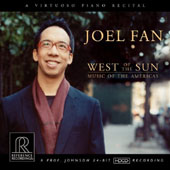
West of the Sun
If you are a piano music buff, are adventurous and like variety in a program, than this great CD of piano works by North and South American composers will bring you
endless hours of listening pleasure. Joel Fan, a versatile and accomplished pianist who is constantly performing around the globe and is a member of
Yo-Yo Ma's Silk Road Ensemble, offers us a buffet of various spicy dishes in this recent collection.
The program launches with an addictive little Brazilian tango by Ernesto Nazareth that will get your foot tapping immediately. It's followed by a
Caprice by that New-Orleans king of the keyboard, Louis Moreau Gottschalk. A Cuban dance that mixes traditional harmonies with Creole rhythms,
all the while showing off the pianist's virtuosity. When Astor Piazzolla takes a break from writing tangos, he can write beautiful moving melodies like
the one found here in his piece titled Flora's Game. It is based on the milonga, a dance from Argentina that existed before the tango. One
of the main works on this recording, is the Piano Sonata No. 1 by Alberto Ginastera, one of my favorite composers from Argentina.
Its second and final movements, full of cross-rhythms, exotic harmonies, and furious energy, are fantastic displays of pianistic writing and demand the most from the
interpreter, in terms of speed and stamina. The contribution from the American Amy Beach is a short piece called Fireflies which
very much resembles a Chopin etude and is probably just as difficult to play well whilst giving it the proper spirit. This excellent program ends with the Samuel
Barber Piano Sonata Op. 26, another piano piece that demands the utmost from the performer. Aside from the beautiful Adagio movement, it is
in a constant state of momentum, and ends with a dazzling show of virtuosity built around a strange but intriguing fugue. Other composers well represented on this
recording are Villa-Lobos, Bonds and Bolcom.
Throughout all of these differing pieces, Joel Fan displays a versatility and brilliant technique second to none, and can easily travel from jazzy New-York style riffs to Cuban
rhythms without effort. My only quibble with this excellent Reference recording is this; and maybe if someone at the label reads this, they could
elucidate as to why this is. From track 3 (Piazzolla) to track 4 (Ginastera) there is a noticeable change in the instrument's tone. The recording sessions occured over two
days, so did they switch pianos at some point, or did they suddenly change the recording set-up, or use different recording equipment ... ? I know this is picking, but I
like to know what I am listening to. So, for new and intricate piano works to spice up your collection, this CD is a definite recommendation.
Jean-Yves Duperron
Back to top
FLOTILLA
(Consort of Saxophones)
Works for various
saxophone formations
Big Shed Music 0802
832929009846
Buy from AmazonFLOTILLA
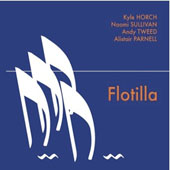
Flotilla is a unique and talented group of musicians, which are considered to be four of the top saxophone players on the British music scene. They
play a wide variety of works that combine all sorts of varied groupings and arrangements for soprano, alto, tenor, and baritone saxophones, with keyboard continuo.
Kyle Horch, Naomi Sullivan, Andy Tweed and Alistair Parnell all have extensive backgrounds in their chosen instrument, including graduate studies
and/or their own previous recording endeavours.
There are seven very contrasting works on this CD that impose diverging demands, both technically and emotionally, on all the players involved. The pieces that reached
out and caught my attention in particular are as follows. The Canonic Suite by Elliott Carter, written in 1945 for four alto saxophones,
surprised me by its freshness and pure tonality. It is a work that definitely combines fun with discipline, and Flotilla demonstrate here that they are a tight ensemble that
can display the humour within music that demands split-second accuracy. The Trio Sonata No. 1 in F major by the Czech Baroque composer
Jan Dismas Zelenka, transcribed here by Kyle Horch for two soprano saxophones, baritone saxophone, and synthesizer (replicating a harpsichord) is faithfully
reproduced. The tone of the instruments is so clean and crisp, that if you didn't know any better, you would think you are listening to two clarinets, a bassoon, and a real
harpsichord. The baroque style is also very well reproduced. At the other end of the musical spectrum is a more recent work by William Sweeney
titled Cha b'ann grad.... A very haunting piece of music with rich overlapping harmonies supplied by three soprano saxophones drifting over a dark
drone on the synthesizer. It will make your mind wander to other times and places. The remaining pieces in this collection are as varied as they are interesting, and are all
played with the same devotion and beauty of sound that defines Flotilla.
If you play the saxophone yourself or love the sound of that evocative instrument, this collection easily demonstrates that jazz is not the only genre where this instrument
belongs. The Zelenka piece alone is ample evidence that the saxophone is as versatile an instrument as any, especially in the hands of this fine ensemble.
Jean-Yves Duperron
Back to top
Lang Lang
Live in Vienna
Sony 2CD-Set
886977190124
Released : August 2010
Buy from AmazonLANG LANG
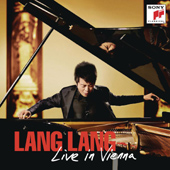
Live in Vienna
After capturing the world's attention with his first recordings on the Telarc label, and then moving on to a series of very successful Deutsche Grammophon recordings,
Chinese pianist Lang Lang has now established a very lucrative recording contract with Sony Classical. All of this and he is only
28 years old. Only time will tell if Sony have made a sound investment in this flamboyant, if not always consistent, musician. We always have to keep in mind that,
regardless of talent or musicianship, tons of marketing money helped to establish his image around the world, and make him a household name.
Why did Lang Lang and Sony decide to launch a new series of recordings with a "live" recording from the Musikverein in Vienna, Austria? Lang Lang himself explains it
this way: "For me, there are few halls around the globe that have the same prestige as Carnegie Hall and the Musikverein. Of course there are other great halls but
I always feel these two have a unique place in people's hearts. So I felt that, after Carnegie Hall, the Musikverein would be the place where I should do another live
recording." And what do you perform in such a reveered and sacrosanct concert hall?
Lang Lang spent weeks prior to the Vienna recital, fretting over and refining the program, and settled on four composers who had played an important role in the
development of music for the piano. Book I, from Iberia by Isaac Albéniz is an obvious and wise choice. It is after all one of the
most important Spanish statements from the piano repertoire. It can also charm an audience with its warmth, something well demonstrated here by Lang. The
Piano Sonata No. 7 in B-flat Major, Op. 83 by Sergei Prokofiev. Another great pick. One of the most influential Soviet era piano
works. Full of advanced harmonic progressions and war-drenched images, wild rhythms and spiky gestures. It can shock and challenge an audience, which is always a good thing.
I've heard more bullish and brutal last movement interpretations, but Lang Lang holds his own with pinpoint accuracy and a superbly shaped slow inner movement. And
now on to the potentially dangerous, but brave and courageous choice. Two Piano Sonatas by Ludwig van Beethoven. The No. 3 in C Major,
Op. 2, and the great No. 23 in F minor, Op. 57 "Appassionata". This Viennese audience could have him thrown out on the street for only
one slip, but surprisingly enough, this is where the recital is at its very best. Lang's interpretation of the master is superb. I would even dare say luminous. Even better than most of the old-school Beethoven specialists.
These are not mere piano pieces. They are epic musical dramas to be performed on a piano. There is a big difference between the two. And Lang Lang knows the difference,
and holds the long thread that runs through these like an old master. He always makes the leading voice sing, and brings all the elements together to keep the momentum going from start
to finish. You can tell that even though he's never recorded any Beethoven before, it sounds as if he's been playing Beethoven every day since the age of 5. And last but
not least, as Encores, he chose to play some Frederic Chopin favorites, which should be part and parcel of any piano recital, but this is where I
disconnect. I find his take on the Etude Op. 25, No. 1 much too mannered and exagerated. The one flaw in his playing is this tendency to over-manipulate
certain pieces, and this is one of them. He also rushes the Polonaise "Heroique" and completely misses the soul at its core. But hey,
these are the Encores and therefore may be less well prepared. To conclude then, the Beethoven alone is well worth the price of admission, on this double CD priced as
one. I can't even imagine how he will play Beethoven when he is 65, he plays it so well now.
I used to be an outspoken naysayer and doubting Thomas when it came to the potential of this pianist. I would always say that he was nothing more than a flash in the pan.
After hearing his refined account of Beethoven on this, his finest recording so far, my opinion has made a complete u-turn, and now I understand the reasoning behind
all that marketing money. The people at Sony Classical have pulled out all the stops on this new recording. It is being released in five different formats,
including a regular 2CD-set, Deluxe limited edition CD/DVD combo, regular DVD, Blu-ray DVD with over 20 minutes of 3D footage from the concert, and on vinyl. The choice
is limitless and varied enough for anyone to be able to enjoy this fabulous recital anyway they prefer. Strongly Recommended!! Even to all the other naysayers out there.
Jean-Yves Duperron - August 2010
Back to top
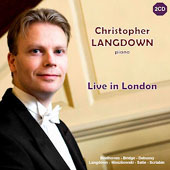
Christopher Langdown
Live in London
(Piano Recital)
2CD Set
Divine Art DDA21218
809730121821
Buy from AmazonCHRISTOPHER LANGDOWN
Live in London
This CD is a live recording of Christopher Langdown, capturing his recital at Wigmore Hall in London, in June of 2009. If anything, it presents to
us a young pianist whose versatility could lead to a bright future on the world stage of pianism. He has already received various awards and collaborated with many
chamber music groups.
The variety of styles and periods comprising this recital could have been a challenge to some pianists, but Christopher Langdown seems to feel right at home no matter
which composer he tackles. Some of the highlights of the evening include very atmospheric Book II Preludes by Claude Debussy.
A solid interpretation of the Piano Sonata in D minor, Op. 31 No. 2 (Tempest) by Ludwig van Beethoven. A rarely recorded but
eloquent Dramatic Fantasia by Frank Bridge which I had not heard before. It is harmonically rich and uses the keyboard's full range
very effectively, and Langdown seems to relish the demands it puts on the player. There are seven Etudes by my favorite composer for the piano,
Alexander Scriabin, which are very well shaped although the profound sadness is lacking in Op. 8 No. 11, and the extremely demanding Op. 8 No. 12
is missing the fiery passion and bravura it requires to really take flight. When Vladimir Horowitz would play this dramatic work, his disposition immediately following its
performance would show a man who had just attained nirvana. The recital concludes with a very Islamic sounding Gnossienne No. 1 in F minor by
Erik Satie. And if that was not enough of a varied program, the recital also includes a few pieces by Moritz Moszkowski and one of
Christopher Langdown's own creations, a very harmonically rich and neo-romantic work titled Deo Omnis Gloria.
Collectors of piano recordings should definitely obtain this strong snapshot of a pianist captured live at the beginning of what points to be a strong concert and recording
career. The variety of the pieces on this recording is enough to satisfy any piano lovers appetite, and might even present new discoveries to some and certainly shed some
new light on old favorites. The Divine Art recording fully captures the recital's atmosphere and nervous energy, and delivers a focused and solid sound
throughout.
Jean-Yves Duperron
Back to top
Caroline Léonardelli
EL DORADO
Caroline Léonardelli (Harp)
Joel Quarrington (Bass)
Penderecki String Quartet
CEN Classics CEN1021
Buy from AmazonCAROLINE LÉONARDELLI
EL DORADO
There is no doubt that of all the musical instruments, the harp produces the most beautiful and pleasant sound.
After all, nothing sounds more angelic than a series of arpeggios played on a harp. And great composers know that to create some great atmospheric effects,
include one or two harps in the orchestration of a score. But, I have always found the harp to be rather unidimensional and lacking in emotional character.
Well, on this her latest recording, Caroline Léonardelli is apt to change my misplaced opinions. The different moods she projects from the instrument
in 'Song of Nymphs' by Marjan Mozetich, should be enough to persuade me of her technical abilities and the harp's capabilities, but throughout every piece
on this CD, she displays not only her remarkable musicianship, but also the harp's various personalities. The introduction of 'Sicilienne Variée' by Jean-Michel
Damase is a great example, the tenderness of 'La Fille Aux Cheveux de Lin' by Claude Debussy and the childish atmosphere of 'Little Shepherd' also by Debussy,
also demonstrate the harp's many facets. And there is an abrupt mood shift when the program closes with the CD's title work 'El Dorado' by Marjan Mozetich.
A piece of music that takes you on a strange voyage to a distant and mysterious land. Here the Penderecki String Quartet and Joel Quarrington provide the
support which sounds like the minimalist rhythm of a steam train taking the harp on a long journey of exploration and strange soundscapes. A work of dark
beauty by Mozetich using his minimalist techniques.
The recording here is superb and the sound of the harp is rich and palpable, and detailed from top to bottom. A definite choice as a harp recording with
the added bonus that all the works on this fine disc have something to say.
This recording was nominated for a Juno Award in the spring of 2010.
Jean-Yves Duperron
Back to top
Matt Haimovitz
Odd Couple
Matt Haimovitz (Cello)
Geoffrey Burleson (Piano)
Oxingale OX2015
800658201527
Buy from AmazonMATT HAIMOVITZ
Odd Couple
The title of this CD, Odd Couple, refers to the fact that the cello and piano combination,
although a pairing first introduced by Beethoven for his great cello sonatas, has always been considered an awkward or maladjusted
blend of instruments. Well, if that were true, a countless number of masterpieces would never have seen the light of day. Instead,
I believe this CD should have been titled Odd Quartet, because the 4 pieces performed here could not be more varied and different
in their demands on the performers, as well as the listeners. Jazzy, romantic, intellectual and atmospheric are the adjectives
I would use to describe each one with only one word.
The first piece on the disc 22 Part 1, by David Sanford, who was born in 1964, is built upon
a very jazzy piano part, with long stride lines in the left hand, punctuated by jabs from the cello for a while, eventually
leading to long sections where both instruments share long, jazz infused lines and bring everything to a punchy meeting of the minds in the end.
This is followed by Samuel Barber's Cello Sonata in C Minor. A very romantic work for a piece written in 1932.
This piece demands, right from the very first notes, a high level of focused emotions, running the gamut from fiery passion to tender
lyricism, with both instruments sharing the lead along the way, with technical and artistic demands always front and center.
The final work, Cantos for Slava, by Augusta Read Thomas, was composed in 2008 and written in
memory of Mistislav Rostropovich, the greatest russian cellist and all-around musician. It is an atmospheric piece of music,
employing many different techniques on the cello, from the plucking of strings à la Jaco Pastorius, to long, gliding textures
and shimmers well supported with moody piano lines. A rather haunting piece following the realist Elliot Carter piece.
A difficult work loaded with ever changing counterpoint and full of interesting interplay and cross-talk between the two instruments.
It is absolute music which demands high levels of concentration from the players at all times to pull it off.
Both Matt Haimovitz and Geoffrey Burleson meet the different demands of these pieces head on,
and imprint their own personalities to the music, branding it as theirs. From the passion of the Barber to the eccentricities
f the Carter, they obviously have this music fused in their minds, and collaborate very well together. They have actually
started, in the fall of 2008, touring with these works and playing live, from concert halls to night clubs. Haimovitz has
always been a strong supporter of music and believes in bringing it to as many people as possible, in as many ways as possible.
For more detailed info on these dedicated musicians and the fine Oxingale record label, please visit www.oxingale.com
Jean-Yves Duperron
Back to top
GISELLE MINNS
Turning Circles
The multi-talented Giselle Minns, singer, songwriter, lyricist, arranger and pianist,
has released her first full-length CD titled "Turning Circles" in September of 2008. She describes it, or rather categorizes it as
"Classicaltronica", which fits the style and sound rather well. Imagine if you can, a mix of Filippa Giordano, Sarah Brightman,
Emma Shapplin, with a darker tinge à la Enya, all done with a powerful, classicaly trained voice and supported by strong, dramatic
and emotional music, and you should get a clear picture of what Giselle sounds like.
These 11 well crafted songs, some with French and Italian lyrics, are all well laid out in their progression from intro
to finish, and some of them play on your emotions and dwell on the mind. The type of song that would fit well in movies
like "Lord of the Rings" or big, epic and gothic inspired video games. The electronic wizardry within the mix has a lot to
do with the overall effect and mood of the music. For example, moments when the music sounds as if it is being heard on an
old radio, or the music seemingly coming from far off, as if in a distant memory from long ago, or the piano sound coming to
you from another room, all of these clever effects create and set the mood of this CD. The genre is definitely more Electronica
than Classical, but there is one song titled "Trois Gymnopédies" that is based on the famous piece by Erik Satie
Giselle was raised and trained in Opera and sung major roles around the world, collaborating with well known classical music figures.
What this CD lacks in classical content it makes up for with its clever electronic sound manipulation and moody arrangements.
You can read more about Giselle and her awards, operatic roles, appearances etc...and listen to video/audio clips of her music at
giselleminns.com
Jean-Yves Duperron
Back to top
Marc-André Hamelin
Kaleidoscope
Hyperion CDA67275
034571172750
Buy from AmazonMARC-ANDRÉ HAMELIN
Kaleidoscope
If you are a big fan of piano music, this CD definitely belongs in your collection.
The title of the disc, Kaleidoscope, could not be more appropriate. Every possible style is on display here. All the pieces were
written by pianist-composers over the last century or so, therefore many different pianistic tricks or techniques are present
within the music; grand waltzes, études, variations, plus lots of shmaltz when needed but mostly a dazzling display of technical
pyrotechnics at the hands of Marc-André Hamelin.
There is simply nothing this pianist cannot do. It wasn't enough that all the works on this disc, from Hofmann, Moszkowski,
Poulenc to Casella, to name but a few, are difficult to play, he added a few of his own compositions to the mix that are even
more technically demanding than everything else. Take for example his Etude No. 3, based on the famous La Campanella by Liszt,
a very demanding piece to begin with. Well, Hamelin just turns up the heat a few degrees more that would bring most other
pianists to their knees, and dazzles with mind boggling speed and dexterity, and a slightly warped sense of humour.
This impressive 2001 Hyperion recording is not just flash and fireworks either. There are a few very lyrical and beautiful
other miniatures on this well-rounded offering. My favorite one being Hamelin's own transcription of the "Petit Adagio"
from Autumn in Glazunov's Seasons. An orchestral work that, by it's orchestral colors, portrays the winds of autumn rustling
through the coloured leaves and the approach of the cold and bleak winter season so well that you would doubt a piano version
would work the same magic. Well, Hamelin's transcription is so literal and so true to the original's melodic flow, using the
range of the keyboard so effectively, it lets you imagine those beautiful fall colours again, and feel that cold wind foretelling
the coming of winter. Beautiful! Inspired and Flawless!
Jean-Yves Duperron
Back to top
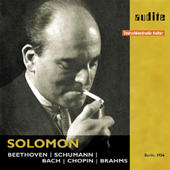
Solomon
The 1956 RIAS Recordings
Beethoven - Schumann
Bach - Chopin - Brahms
Audite 23422
Released : Sept 2010
Buy from AmazonSOLOMON
The 1956 RIAS Recordings
Solomon Cutner (1902-1988), whose stage name was simply Solomon, was a British/Polish
pianist who launched his career at the age of seven, by playing his own piano version of the 1812 Overture in front of the
family. Even though he suffered a nervous breakdown in 1916, and stayed out of the public eye for over five years, he did go
on to resume a professional career of legendary status which lasted until 1956 when he suffered a major stroke, just a short time
after this recording was captured.
Beethoven: Piano Sonata No. 3
Beethoven: Piano Sonata No. 14 [Moonlight]
Schumann: Carnaval, Op. 9
Bach: Italian Concerto
Chopin: Fantasie in F minor, Op. 49
Chopin: Nocturne in B-flat minor, Op. 9, No. 1
Chopin: Scherzo in B-flat minor, Op. 31
Brahms: Intermezzo in E-flat minor, Op. 118, No. 6
Brahms: Intermezzo in E major, Op. 116, No. 4
Brahms: Rhapsody in B minor, Op. 79, No. 1
These works, taped in a recording for German Radio Broadcasts in 1956, capture Solomon at the peak of
his output, in full command of the keyboard, and in control of even the most subtle dynamic shadings that make the difference
between a bad interpretation and a good interpretaton. The way he shapes the slow middle movement of the Italian
Concerto for example is very well done, and besides a couple of little slips in the left hand of its fast final movement,
it remains a convincing interpretation. The Beethoven sonatas are steady and solid in their determination.
The Chopin Nocturne glows with a natural beauty that eschews sickly-sweet sentimentality, but instead finds
the magic behind every note. Solomon even hums in this one, here and there, captured by the moment's emotion. His version
of the Scherzo is electric, and you can sometimes hear the felt of the dampers rubbing against the piano
strings, as he slightly depresses the keys in anticipation of a powerful chord. And he completely throws himself, body and soul,
into the world of the Brahms Rhapsody.
The recordings are mono, but still rich enough to convey the piano's dynamic range and deep tone. The Audite
remastering sessions were drawn from the original master tapes from the broadcasting archives, and therefore bring back to life
these 50 year old legendary performances.
Jean-Yves Duperron
Back to top
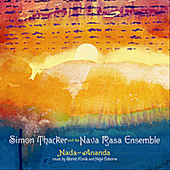
SIMON THACKER
The Nava Rasa Ensemble
The Edinburgh Quartet
"Nada-Ananda"
Slap The Moon Records
0609722889124
Released : June 2011
Buy from AmazonSIMON THACKER
"Nada-Ananda"
A coming together of different worlds, a clash of ideas, a kaleidoscope of styles could be some of the words one might use to define the music on this new CD. Other
descriptions may include east meets west, existential meets urban, classical meets ethnic, or Shankar meets Pärt. I myself even hear subtle shades of Frank Zappa as a
composer, and strands from the score to the film 'More' by Pink Floyd. But one definite qualifier is that this music lies at the existential level, and even though the two
pieces on this recording are both categorized as guitar concertos, in many ways they are more than that.
The Birth of Naciketas for guitar concertante by British composer Nigel Osborne (1948-), described by himself as a
search for an Indian classical modernism, is a fascinating work that, regardless of its strict structure built around Indian rhythmic and scale patterns, manages to pull
you into its own strange and unique sound world. Its orchestration for classical guitar, Indian violin, tabla, percussion, double-bass, string quartet, and waterphone,
creates a magical combination of sonic textures and dreamworld imagery, that continuously rivets your attention on the unfolding music. Western modernism enhanced
by ancient Eastern sounds. From a different angle, the concerto for guitar and chamber ensemble Nada-Ananda by Shirish
Korde (1945-) is a much more extrovert and straightforward piece of music meant to challenge the guitarist with its unusual harmonic intervals and melodic phrasing.
It's interesting to hear a classical guitar and string quartet bending notes to reproduce the exact semitones within the music. Eastern tradition enhanced by western instruments.
Two works attaining the same musical upper foliage from completely diverse and opposite roots.
The musicianship on this recording is quite remarkable. Guitarist Simon Thacker transcends the instrument and persuades it to produce music loaded
with subtle nuances and character. The Edinburgh Quartet, whose repertoire ranges from Haydn to Seiber, take on a different role here and become
the core of the music and create the rich sound that sets the atmospheric ambience and becomes the guitar's cradle. They actually form part of the Nava Rasa
Ensemble, musicians hand-picked from some of the best specialists of Indian music. A veritable melting pot of styles and influences that have truly merged into
one. If you would like more info you can visit Simon Thacker's website here.
Jean-Yves Duperron




 HOME
HOME